Thanks to Queer Heaven of
I got the name of this nice delicious man squirting his cum

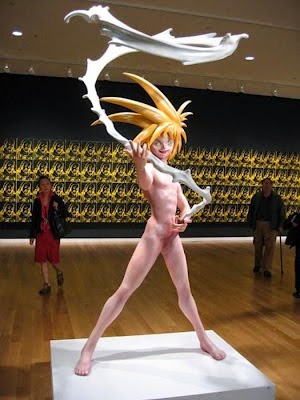
Takashi Murakami: My Lonesome Cowboy 1

Takashi Murakami: My Lonesome Cowboy 2

Takashi Murakami: My Lonesome Cowboy 3

Takashi Murakami: My Lonesome Cowboy 4
Among Murakami’s most celebrated works is the sculpture My Lonesome Cowboy (1998), a life-size depiction of a naked boy, proudly spouting a stream of white semen that circles around him in the style of a lasso. The work is an appropriation from the popular genre of erotic manga, otaku, transformed into an art object through the title’s reference to Andy Warhol’s 1968 film Lonesome Cowboys. With bright plastic blue hair and cartoon features, it is cute and colourful enough to appeal to a general audience at the same time as carrying off a semblance of social critique through its exaggerated sexuality and references to 1960s Pop art. Yet to what extent does My Lonesome Cowboy simply reproduce a popular fetish, thereby reinforcing the socio-economic conditioning of consumer desire, as opposed to providing insight or critique?
The design of the figure was modeled after a similar character in otaku animation, and in order to be as faithful to the genre as possible, Murakami employed commercial manufacturers to produce the piece. There is no sign that Murakami was attempting to challenge or modify the otaku stereotype, with its abstraction of human desire and affirmation of sexual fantasy according to social constructs. The trail of semen that encircles My Lonesome Cowboy is the most obvious example of this fetishism – the human bodily fluid is stylised and converted into a static, plastic model of imaginary dimensions. Human experience is thus transformed into an object that emits other-worldly qualities, with a dollar price to match. It becomes a commodity that fuels the drive to consume unnecessary goods. In Marx’s terms, we are talking about commodity fetishism. The commodity is not produced to satisfy primal needs or desires, but to enhance an unnecessary cycle of production and consumption, abstracted from human necessity. The single feature of the work that might remind us of human desire and bodily experience is brandished, cowboy-style, as a plastic weapon.
There's also a female version:

Takashi Murakami: Hiropon 1

Takashi Murakami: Hiropon 2
Murukami’s celebration of the reified commodity is even more evident in the design for Hiropon (1997), the female counterpart to My Lonesome Cowboy. Hiropon’s adolescent body is precariously balanced on one pointed foot, her tiny frame completely dwarfed by two bulbous breasts that explode from a tiny bikini. Only her elaborate blue hair competes with the presence of the breasts, from which milk spouts. The milk forms a complete circle around her, doubling as a skipping rope. Like My Lonesome Cowboy, Hiropon was not created as a critique of the way women are represented in otaku culture. Instead, it directly appeals to the market. Murakami admits, “Because making a life-size figure is really no different than making a sex doll (a dutch wife) in the context of the anime figure, it’s safe to say it ours was a fairly shameless plan from the start.”
This desire to conform to, rather than challenge, the otaku market was made even more transparent when Murakami decided to remodel Hiropon as a new character, Miss Ko2, to be more in line with the sexual fetishism of the popular genre. Indeed, when Murakami approached a leading contemporary otaku designer about using one of his computer-game characters as the model for Miss Ko2, Murakami received a skeptical response. The designer, who is known simply as ‘Bome,’ replied, “This game is an utterly artless pandering to stereotypical otaku fetishism. Nor is it original – rather it was created with a complete understanding of the tastes of the entire otaku market for uniform fetishism.” To which Murakami said, “That’s what I want.” The problems associated with this critical ambivalence become more apparent in the context of Murakami’s subsequent forays into overt commercial production.
here a video where Takashi Murakami explain his works!